For most of the 1980s and into the early 1990s, entering the software field required a specific kind of unreasonableness. Career paths were poorly defined. Financial rewards were uncertain. The cultural identity was niche to the point of invisibility. You entered because a question pulled you: what can this machine be made to do? That question, not a salary band or a career plan, was what the field selected for. And because entry required a certain stubbornness about the question, the people who entered were disproportionately the kind who did not need coordinating. They self-aligned around problems. Teams were small. Trust was high. Ceremony was minimal.
Then the financial logic of technology became legible to the wider world.
The dot-com boom of the late 1990s was the inflection point: the first time that financial upside, rather than technical fascination, became a plausible primary motivation for a significant fraction of people entering the field. What followed was not a corruption of the field. It was the field responding rationally to real demand. Enterprises needed software at scale. The market needed programmers at scale. Supply followed. Each wave of expansion, digital transformation in the 2010s, the COVID-era acceleration through bootcamps and career changes, brought more people in and shifted the motivation profile of the marginal entrant. By the early 2020s, almost half of working engineers had entered the profession within the previous decade. The field had industrialized.
This is not a moral observation. It is a structural one.
What the Field Actually Grew
The expansion produced two distinct kinds of programmers, and conflating them is where most current commentary goes wrong.
The first kind used code as an instrument of inquiry. They were asking computational questions and writing programs to answer them. The code was necessary but incidental: a means of directing a machine toward a problem they genuinely cared about. What mattered was the outcome, the behavior of the system, the thing that did not exist before they built it.
The second kind were trained for something different, and trained well: to take a defined specification and convert it into working code. The thinking happened elsewhere, in product management, architecture, business analysis. The programmer was the translation between a known requirement and a running program. This is a real skill. It was genuinely valuable. The industry needed it at enormous scale, and the industry got it.
The distinction is not about intelligence or effort. It is about what the work was in service of. One group was pursuing a question. The other was completing a conversion. Both were called programmers. They were doing fundamentally different things.
What AI Has Changed
AI-assisted development has moved into the conversion role. Not partially. Structurally. The work of taking a defined specification and generating working code is precisely what modern coding agents do with increasing competence. This is not a gradual encroachment. It is a categorical shift in where the bottleneck sits.
The bottleneck has moved upstream. It now sits at the point where intent must be formed, structured, and held under pressure. Clarity of specification determines quality of output. Vague requirements no longer get absorbed by a skilled programmer iterating toward a solution. They produce noise at scale, faster than ever before.
This was already visible in a conversation I had recently about what separates teams moving fast with AI from those that are not. The answer was not tooling. It was not infrastructure. It was the ability to say clearly what they wanted built and why. The teams that could form and hold intent were the teams that could use the tools. The others were generating complexity faster than they could manage it.
That capacity, the ability to form and hold intent, is a builder capacity.
The Builder Is Not a Personality Type
Here is where the framing needs precision, because "builder" is a term that gets used carelessly and often carries a faint condescension toward everyone it excludes.
The builder is not a personality type. It is a mode of working: curiosity directed at a problem, code used as the instrument for answering a question rather than fulfilling a specification. What matters is not how someone entered the field or which decade they learned to program. It is whether they are oriented toward the question or toward the conversion.
That orientation is more widely distributed than the mythology of the original field suggests. It exists in programmers who arrived in 1989 and in programmers who arrived in 2019. It exists in people who came through bootcamps. It exists in people who came through mathematics departments. It exists, quietly, in many people who spent years doing conversion work because that was what the market paid for, and who never stopped being curious about what the machine could actually be made to do.
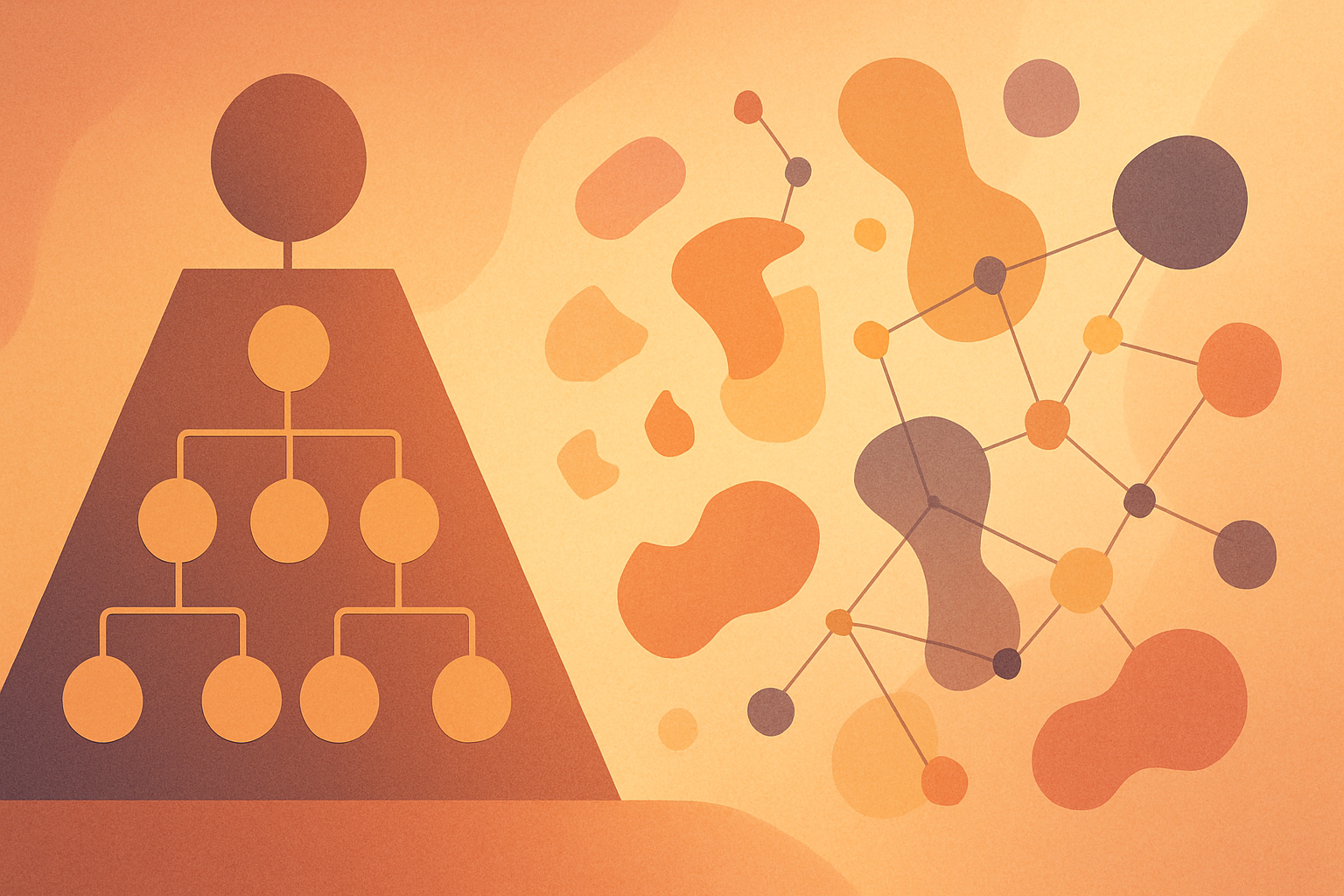
The industrialization of the field did not eliminate builders. It diluted them. The ratio changed. The coordination overhead grew to manage a workforce that was no longer self-aligning around intrinsic technical goals. The entire architecture of modern software delivery, Scrum, sprint ceremonies, project management layers, story point estimation, was built to substitute for the alignment that curiosity once provided. The workshop became a factory, and the factory needed foremen.
AI is dismantling the factory floor. What that means for the foremen is a genuine and uncomfortable question. But what it means for the field is clearer: the premium is returning to people who are oriented toward the question.
What Organizations Need to Understand
The organizational implication is the one that most commentary misses, because it focuses on individual roles rather than structural capability.
Organizations that will move effectively in an AI-assisted world are not primarily the ones with the best tooling. They are the ones that can form and sustain intent while the technology moves underneath them. That requires a different kind of organizational literacy: not process compliance, but clarity of purpose. Not Scrum masters, but people who understand the domain well enough to specify what they want with precision.
The coordination layer, valued at over seven billion dollars in project management software alone, was built to manage a workforce that could not self-coordinate. As the conversion work automates, that coordination layer contracts. What replaces it is not more process. It is deeper domain understanding, held by smaller teams, expressed with enough clarity that machines can act on it.
That is a different kind of organizational readiness than most enterprises have invested in. It is also the kind that cannot be purchased off a vendor roadmap. It has to be built.
The Field Returns to Its Original Shape
I brought my first TRS-80 home at fourteen. What that machine did to my thinking was not teach me to program. It taught me that I could tell a machine what to do and watch it actually do it. That feeling, the feeling of directing computation toward a question and seeing an answer appear, was the thing the field was built on. It was what pulled people in before the financial logic made pulling unnecessary.
Using a modern coding agent to build something real, a content management system, an inference pipeline, a feed, feels like that again. Not because the tools are nostalgic. Because the nature of the work has returned to the question. You think clearly, you specify clearly, and the machine builds. The quality of your thinking becomes the quality of the system. The abstraction layer that once required syntax mastery now requires clarity of intent. That is not a step backward. It is the logical next step in a progression that has been running since the first programmer replaced a switch with an instruction.
The field is not returning to 1980's. The web happened. Distribution is solved. The economics of software delivery are permanently different. We are not going back.
But something is returning that matters more than the economics: the primacy of the question over the conversion. The builders who were always asking what this machine could be made to do are about to find that the field has reorganized itself around exactly that capacity.
The factory floor is being automated. The workshop is opening again. And the people who were always there for the question, not the salary, not the ceremony, not the story points: they know what to do next.