
Meaning Is Not Enough
I have always believed that software should carry the load instead of handing it back to the people using it. For years that belief had a single clear target, the flowchart. Enterprise software took work that people understood and locked it inside rigid sequences of screens, then asked people to navigate the sequence on the system's behalf. I argued, and I still argue, that software should process meaning rather than enforce procedure.
Although that argument is correct, it is unfinished. Meaning is necessary, but it is not all that is needed. A system can hold a precise model of what an invoice is, how it relates to a purchase order, and which states it is allowed to occupy, and still have no way to decide whether approving it now is the right move. A richer model does not close that gap. A system can describe its world in exhaustive detail, every entity, state, and relationship in place, and still sit inert, waiting for a person to tell it what the description means for what happens next. Knowing what something is and knowing what to do about it are not the same ability. The first is meaning, the second is reasoning, and enterprise software is only now learning the difference between them.
Knowing Is Not Deciding
Let us consider an instruction that sounds trivial, "approve the invoice if everything looks correct." A traditional system can present the invoice, validate that the fields are complete, and confirm that the person clicking approve holds the right permission, but lacks the capacity to judge. The phrase "if everything looks correct" describes a judgment, and judgment was the one thing the system was never built to perform. So it handed the judgment back to a person, every time, and called the handoff a workflow.
A reasoning system treats the same instruction as a decision rather than a transaction. It reads the state of the invoice, the policy thresholds that apply, the history of this supplier, the relationships to the purchase order and the project the invoice belongs to, and the probability that approving now is safer than waiting. It weighs those factors against one another. If its confidence is high and the constraints are satisfied, it approves. If confidence falls, it escalates to a person, with the reasons attached. The invoice clears no faster than before, but what has changed is that the system now forms a view before it acts.
The Capacity to Evaluate
This ability has a name, and terminology is important because the industry keeps reaching for vaguer words. Intelligence overstates it and automation undersells it. This is evaluative capacity, being the ability to weigh options, compare outcomes, and select an action based on confidence and constraints rather than on a path drawn in advance. Evaluative capacity is what separates a system that follows a decision from a system that makes one. Automation repeats a choice that someone already made, whereas evaluative capacity makes the choice.
The shift comes into focus when set against everything that preceded it. Workflow systems route, moving a task from one box to the next along a path a designer fixed ahead of time. Semantic systems interpret, grasping what the task is and how it relates to everything around it. Reasoning systems evaluate under uncertainty, working out what should happen when the path was never drawn and the answer is not certain. Each capability contains the one beneath it. Routing alone is brittle and interpretation alone is inert, so it is the third that finally acts.
Confidence Is Not Correctness
Here the argument turns, because evaluative capacity introduces a problem that deterministic software never had to face. A system that evaluates can be confident and still be wrong. Confidence is the system's own estimate of how likely its decision is to hold. Correctness is whether the decision actually held. The two are different things, and the discipline of running a reasoning system rests on never confusing them. A system can read a duplicate invoice as routine because every field matches a familiar pattern, assign the decision high confidence, and approve a payment that should never have been made. The pattern was real, but the conclusion was false. Organizations that treat high confidence as proof of correctness will automate their mistakes faster than they ever made them by hand.
The answer to that gap is not a higher confidence threshold but a deterministic floor beneath the reasoning. A reasoning system proposes under uncertainty, but nothing it proposes commits until it has cleared the business's hard rules. The invoice must not be a duplicate, the entries must balance, the purchase order must exist and match, the period must be open. Each of those is a fact, checked the same way every time, regardless of how confident the reasoning was. Confidence belongs to the reasoning layer, and validity to the deterministic layer beneath it.
This is why reasoning is best understood not as the removal of uncertainty but as its management. The old systems eliminated uncertainty by refusing to operate inside it. If a rule did not cover the case, the system stopped and waited for a human to instruct it. A reasoning system stays in motion, assigning a confidence to its read of the situation, acting where that confidence clears a threshold the organization has set, and surfacing the cases where it does not. That threshold is not guesswork. The organization calibrates it against outcomes, tracking how often decisions at a given confidence level prove correct and moving the boundary until the two figures align. Calibration earns a system the right to expand what it may do without human intervention. Raw confidence earns nothing. And calibration is not the whole story, because the deeper the meaning a system reasons over, the less it has to guess. Handled this way, reasoning becomes a disciplined way of acting inside doubt instead of waiting it out.
The Reasoning Layer
Once a system can do this, the architecture reorganizes around it. The transaction engine, the ledger that records what happened and enforces that it happened correctly, loses none of its importance. It is the deterministic floor the reasoning rests on, foundational the way a database became foundational, essential and undifferentiated at the same time. Above it sits the meaning layer, the structured representation of what the business's objects are, how they relate, and why they exist. And above the meaning layer, a new element appears that the old stack never contained, which I call the reasoning layer, where the system weighs its options and chooses whether to act or wait. The reasoning layer is not a smarter screen bolted to the front of the system. It is where the system decides what action is justified next, a distinct architectural tier between meaning and execution, and it is where competitive value now gathers.
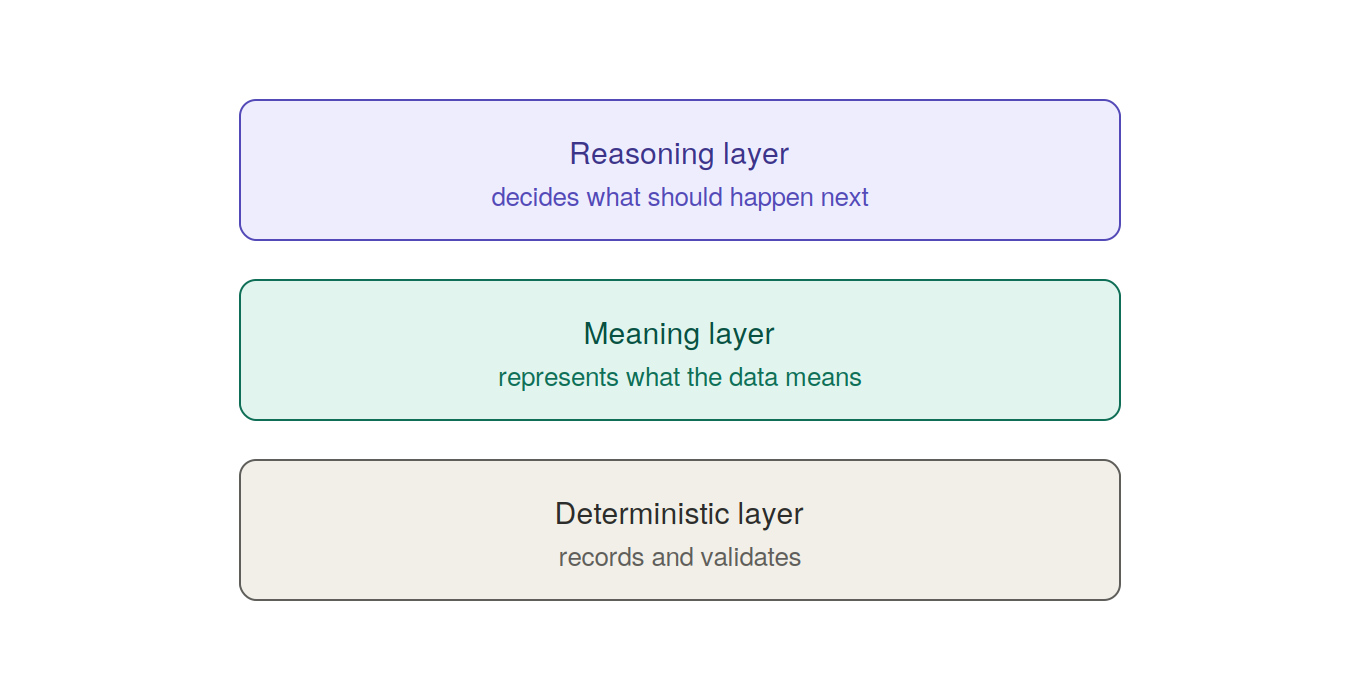 The stack, bottom to top: record, represent, reason.
A reasoning layer cannot stand on its own. It depends on three things working together, and the absence of any one of them collapses the capability entirely. The first is semantic structure, because a system cannot reason about an invoice it does not understand. Reasoning runs on meaning, and it can never exceed the depth of meaning the system has been given. The second is an evaluative mechanism that weighs evidence, likelihoods, constraints, and possible outcomes, and locates the point where its confidence runs out. Without it, agents are fluent and shallow, able to describe a decision but not to ground one. The third is the element that makes the first two safe to deploy.
Governing Autonomy
That element is the control plane. In the old architecture, control lived inside individual screens and workflows. Each module enforced its own rules, and a person initiated every action those rules governed. That was adequate while humans pulled every lever, but it becomes inadequate the moment a system begins to act on its own. Autonomy without governance is not capability. It is exposure.
Consider procurement, which traditional systems broke into a chain of disconnected steps. A person moved each requisition by hand from approval to purchase order to receipt to invoice to posting, holding the connections between those steps in their own head. In a reasoning system, procurement stops being a set of screens a person clicks through and becomes a stateful process with encoded intent, obligations, and relationships. A requisition enters, the meaning layer attaches its context, the reasoning layer evaluates what should happen next, and the control plane confirms that each transition is permitted before it occurs. Rather than a person pushing the work forward, the state of the process pulls it forward, while a governance fabric quietly checks every move against policy and constraint, allowing what is permitted and refusing what is not.
The control plane answers a different question again. Before anything commits, it decides whether the system is even allowed to act, whether this agent, or the person it stands in for, may see this data and make this move under the organization's access rules and whatever regulation applies. It is also where an organization sets its own tolerance for autonomy. A finance team can demand human sign-off above a threshold while a procurement team grants broad latitude for routine purchases, and the same control plane holds both. Autonomy and oversight stop being opposites and become a dial the business can turn. Put the pieces in sequence and the runtime is simple to state. The reasoning proposes, the control plane decides whether the move is permitted, and the deterministic layer decides whether it is valid. Only what clears all three commits.
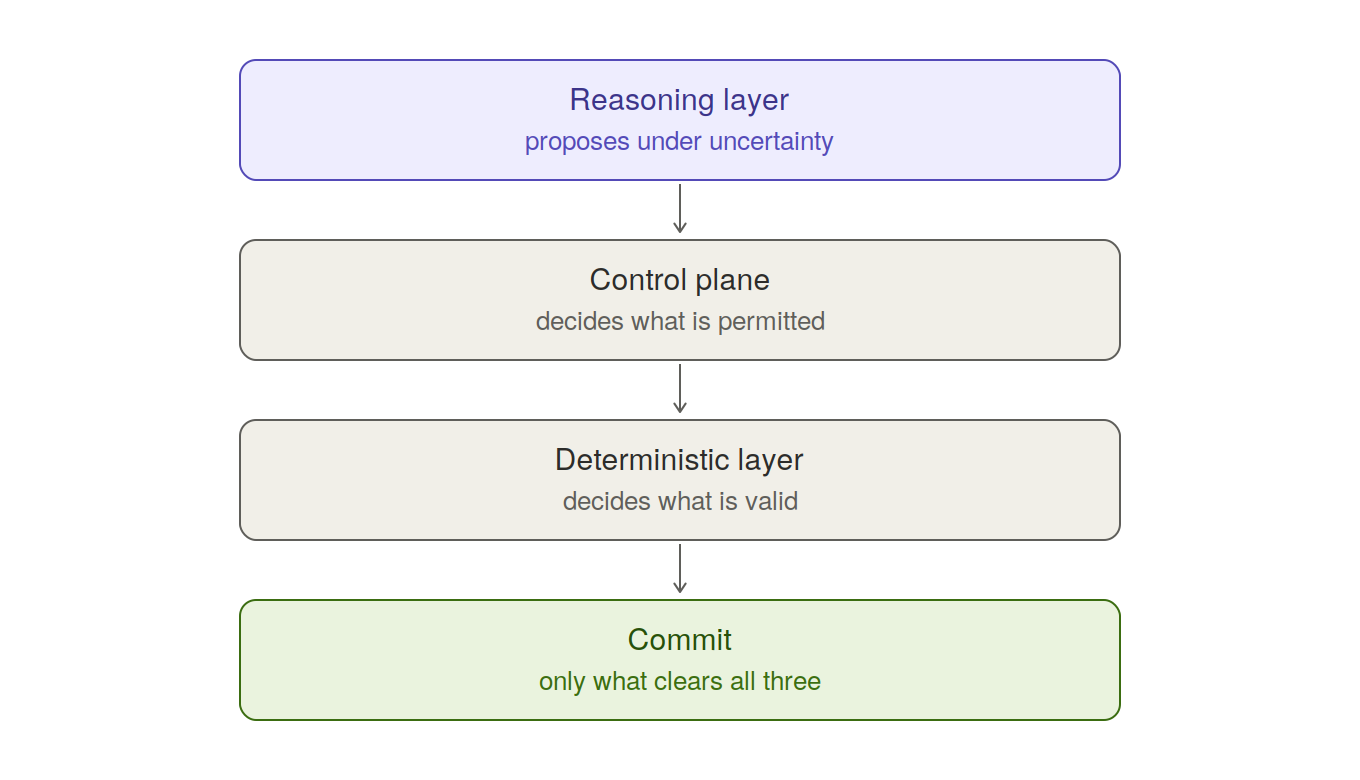 The runtime: a proposal commits only after it clears all three.
Where the Burden Moves
Return to the three verbs for a moment, because the progression they describe is really a progression in where the burden sits. When systems only routed, the burden of deciding rested entirely with the person, and the software's contribution was to remember the sequence. When systems learned to interpret, the burden of translation lifted, and people no longer had to think in the system's objects and screens, because the system could meet them in the language of the work. When systems begin to evaluate, the burden of deciding starts to move as well, partially at first and always under supervision. Each step carries load off the person and onto the system, being the point all along. Reasoning is the stage at which the shift finally reaches the decision itself.
There is a thread here that runs back through everything written before about intent. The persistent failure of enterprise software was that it recorded what people did and discarded why they did it, leaving the reasons in human heads and the system blind to them. Intent was the missing infrastructure. A reasoning layer is what becomes possible once that infrastructure is finally in place. When a system can hold not only the state of the work but the purpose behind it, it can do the thing intent was always meant to enable. It can decide. Reasoning is what processing intent looks like when the architecture beneath it is complete.
The change is easy to understate, because it arrives quietly, as a system that escalates a little less often and progresses a little more on its own. But the line it crosses is not small. Storing meaning made enterprise software comprehensible. Reasoning over that meaning makes it capable. The systems now being built no longer wait to be told step one, step two, step three, but evaluate, within boundaries we set, which step should come next. That is the shift from a system of record to a system of reasoning, and it reorganizes the entire stack above the ledger.
The Question That Remains
It also exposes the question that everything above it depends on and nothing above it answers. A reasoning system can never reason past the depth of meaning it has been given. Its judgment is bounded by the richness of the semantic model beneath it, and that richness is not generic, because the meaning of a contract, a project, or an obligation shifts from one industry to the next. If reasoning is only as deep as meaning, then the depth of meaning is where advantage will be won or lost. Where that depth comes from, and why it is so difficult to copy, is the question worth asking next.