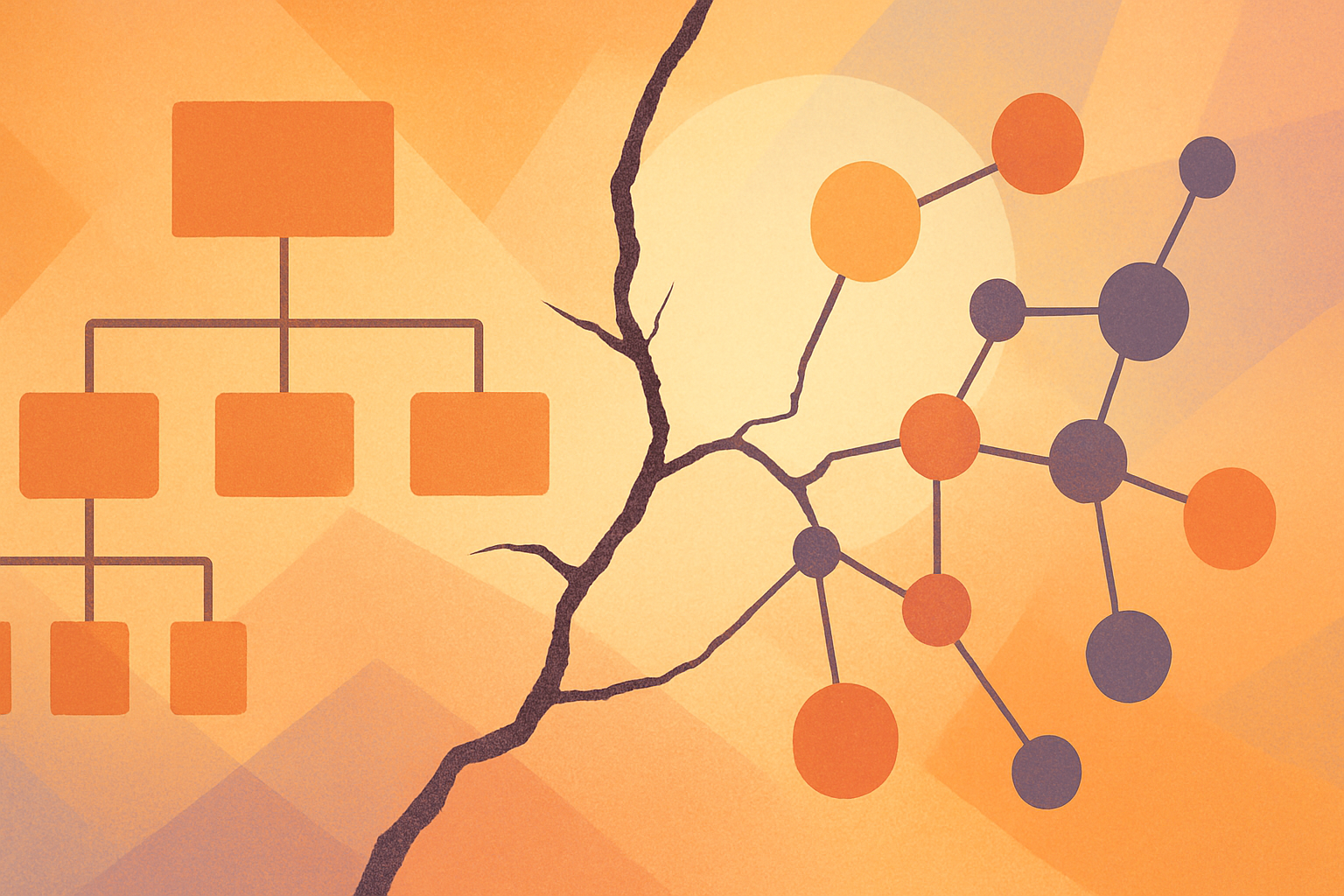
Two Graphs
Every company is two graphs at once. The first is the org chart. It records who reports to whom, where authority sits, how decisions escalate, and who is responsible for developing whom. It is the structure the company publishes, the one new hires study and consultants redraw. The second graph is rarely drawn at all. It is the value chain, the path value actually takes through the company, from a customer need to a delivered outcome, crossing whatever functions happen to lie between.
These two graphs describe the same company, and they almost never share a shape. The org chart runs vertically, organized around authority and the lines along which it flows. The value chain runs horizontally, organized around outcomes and indifferent to which department owns each step. A single order moving from sale to fulfillment to support to renewal touches half a dozen boxes on the chart, in an order the chart was never drawn to express. The work goes sideways. The structure goes up and down.
Companies have always known this. The whole vocabulary of corporate improvement is built on the knowledge. The phrase cross-functional only means something because functions are walls. End-to-end only means something because the ends sit in different reporting lines. Terms like value stream and process owner exist to name a flow the vertical structure does not natively support. The language is a standing admission that the graph the company publishes is not the graph the work follows.
Closing the gap between the two graphs was never free. It took meetings and a standing layer of people whose job was to carry information across boundaries the structure had erected. Standups reconciled the two graphs at the team level. Steering committees reconciled them at the program level. Program management offices existed almost entirely to hold the value chain together across an org chart that kept pulling it apart. This was real work, and for most of corporate history it was simply the cost of operating. The bridges between the two graphs were where much of the company's management capacity went.
Why the Chart Won
For most of corporate history the chart won, and it won for reasons that had nothing to do with whether it described the work accurately. It prevailed because it carried the functions the company could not run without. Authority needed somewhere to sit and someone to route it. Decisions that exceeded one person's mandate needed a path upward to someone who could make them. Performance needed to be evaluated, and evaluation ran along the lines where one person could observe another's work. None of these functions cared about the value chain. All of them ran on the chart.
The chart did more than depict authority. It was how coordination actually happened. When information had to cross a functional boundary, it crossed by moving up one reporting line and down another, because that was the only path the structure supported. The chart held because routing held, and hierarchy was the only structure companies had for institutionalizing it at scale.
This is why value-chain thinking kept surfacing and kept failing to take hold. The idea that a company should organize around how value moves is not new. Porter gave it a name and a diagram in the 1980s. Lean built an entire discipline around the value stream and the waste between its steps. Business process reengineering proposed tearing the functional structure down and rebuilding the company around its processes. Later the Spotify model drew squads across functions, and scaled agile frameworks elevated the value stream to a unit of planning. Each of these surfaced the chain as the structure that mattered. Each was absorbed back into an organization that still escalated and evaluated along its reporting lines.
The pattern is consistent enough to be instructive. The chain could be named and mapped, and the work would still run on the chart underneath, because naming a flow does not move the authority the flow depends on. Reengineering could redraw the processes, but someone still had to approve the budget, and approval climbed the hierarchy. The value chain was always the better description of the work and never the operational structure, because it could not carry routing. Those bridges stayed expensive, and for decades they stayed worth paying for.
When the Chain Surfaces
Routing was the chart's monopoly. For as long as moving a decision or a piece of information across the company required a person to carry it, that person sat on a reporting line, and the chart stayed primary. Agentic systems end the monopoly. When an agent can route a request to the right context and carry the result across a functional boundary without convening anyone, routing stops being a scarce human act and becomes a property of the system.
The coordination layer changes its standing. Where it was the default mechanism through which work crossed the company, it becomes one path among others, and increasingly the exception rather than the rule. Much of what that layer did was never routing in the first place. It was deciding which legitimate objective yields when functions want incompatible things, the exception sales wants for a deal weighed against the control security will not give up, delivery speed against architectural coherence. An agent can surface that trade-off and sharpen the choice, but the choice itself stays human. What remains is the smaller and harder layer of judgment, negotiation, and governance that sits beneath routing and outlasts it.
The argument worth stating plainly is about ownership. End-to-end ownership has always existed in some form, in the general manager and the process owner with a mandate across functions. What made it rare was the cost of exercising that mandate, which meant repeated human coordination across domains that reported elsewhere. In an agentic model that cost collapses. A single line of ownership can carry a value stream from intent to delivery, because the coordination that used to require a department now runs underneath, inside the system. The chain that was expensive to own end to end becomes something a small team owns by default.
The value chain does not replace the organization. It replaces the org chart as the default topology through which operational work is coordinated. The reporting line does not disappear. It becomes the structure through which the company develops people, maintains professional standards, allocates scarce capability, and carries formal accountability. But it is no longer the default route through which work must travel. That role shifts to the value chain.
Conway's Law and the Causal Inversion
For more than fifty years, software has carried the shape of the organization that built it. Conway observed the mechanism in 1968. Any system an organization designs will reproduce the communication structure of that organization. The observation has held across every shift in language and platform since, because it describes something more durable than technology. It describes how coordination leaves its fingerprint on whatever the coordinators produce.
For most of that history, the org chart stood in for the communication structure. Routing ran along reporting lines, decisions escalated up the hierarchy, and information moved through the same vertical channels that defined authority. Software came out shaped accordingly. It came out vertical.
Enterprise software in particular inherited the silos of the departments that commissioned it. ERP is the clearest case. Finance, human resources, procurement, and manufacturing each became a module, and each module mirrored a department that reported up its own line. The architecture was a map of the org chart, rendered in code.
Conway's Law is not breaking in the agentic world. It is holding, exactly as it always has. What changes is the input. When agents absorb routing, the communication structure of the company is shaped by the value chain rather than approximated by the org chart. In this model the communication structure increasingly lives in the specifications, interfaces, permissions, and shared state through which work is coordinated. Information moves across functions rather than up and down reporting lines. Conway's Law, faithful as ever, produces architecture in that new shape. Flatter. Lateral. Organized around outcomes rather than around the departments that used to own them.
What inverts is not the law. It is the direction of cause. For decades the org chart shaped the software, the structure of authority came first and the systems followed. In a specification-driven, agentic world that order reverses, quietly and then completely. Value-chain-shaped software becomes part of the operational structure through which the company runs, and the reporting structure increasingly adapts around the work that software makes visible and executable.
For architects, this is the point that matters most, and it is more demanding than it first appears. Outcome-shaped software is not a design goal to aspire to. It is a consequence to expect. Architects who keep building along the old functional silos will find that the silos no longer match where the work flows, and the friction will compound until the architecture gives. Conway's Law does not ask permission. It produces the shape of whatever coordination it is given, and the coordination has moved. What that leaves of the old chart is the question every company is about to answer, most of them without deciding to.